

The enormous volume in which high-strength chemical anchors are used is evident to industry insiders. Their role in engineering as structural anchoring components is self-evident, and contractors must never treat installation lightly.
Daring often says: half depends on the product, half on the installation. On reflection this makes sense, since the quality of installation often directly determines the overall quality of the project. I previously wrote an article on the installation method of high-strength chemical anchors, which explained the installation steps in detail and mentioned the importance of hole cleaning and dust blowing. This article stands alone to emphasize how crucial hole cleaning and dust blowing are to chemical anchor installation as a whole.
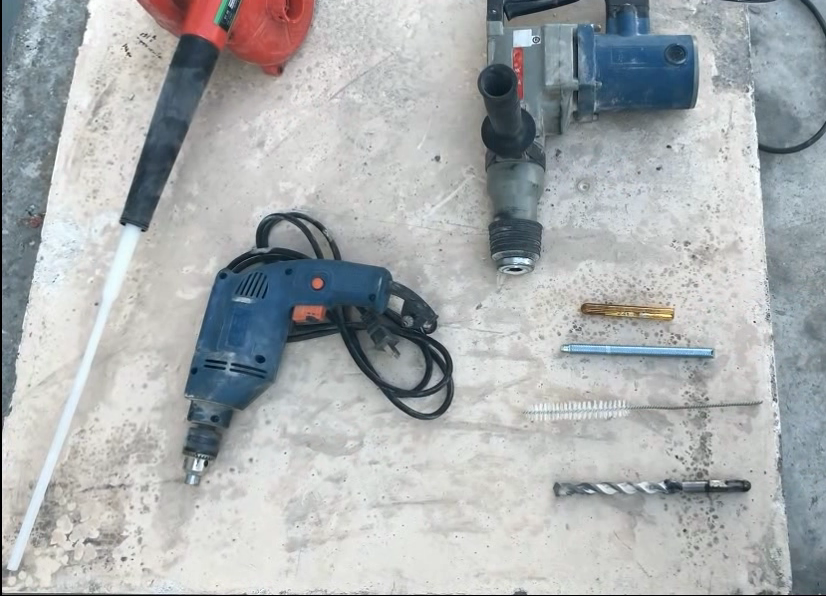
Figure 1: Overview of chemical anchor installation tools
Load capacity without hole cleaning
Some time ago I attended a technical exchange meeting held by a real estate developer, where a supervisor said that in two years he had never seen any contractor clean and blow dust from the hole when installing chemical anchors—how alarming that is. It is no exaggeration to say that hole cleaning and dust blowing is the soul of chemical anchor installation, but contractors either lack the knowledge or, to save time, end up omitting this crucial step.
Take a standard M12×160 grade 5.8 chemical anchor as an example: under standard installation its pull-out force can exceed 50kN, but without hole cleaning and dust blowing the overall load capacity is reduced by roughly half. If the capacity is then 25kN, safety is already quite low: with a safety factor of 2.5, it is safe only when the design value is below 10kN, yet in practice design values are mostly 10-13kN, leaving the safety of the overall structure in doubt.
How clean must the hole be?
Compared with mechanical anchors, hole cleaning for chemical anchors is more demanding, because dust severely affects the adhesion of the adhesive, so the requirements for treating dust inside the hole are higher during chemical anchor installation.
Daring's recommended procedure is as follows:
1. After drilling, use a dust blower to remove most of the dust;
2. Then use a brush or rotary brush to clean dust from the hole wall;
3. Finally, blow the hole again with the dust blower until no visible dust emerges from the hole.
With the hole cleaned this way, the M12×160 chemical anchor above can basically achieve a load capacity of 50-60kN, which is quite a good result. In practice, however, such careful work is rare, so I also conducted corresponding experiments: after drilling, if the hole is only blown with a dust blower until no visible dust emerges and the chemical anchor is then installed, the load capacity can still easily exceed 40kN, and chemical anchors installed this way are basically free of major safety issues, yet workers skip even this step.
What can anchor manufacturers do?
As a chemical anchor manufacturer, we also provide corresponding technical support after the sale. First, before construction we conduct technical briefings for contractors and supervisors, and provide supervisors with corresponding supervision and sampling inspection methods to ensure the project proceeds safely. In addition, to cope with special conditions, the chemical cartridge supplied with Daring chemical anchors contains slightly more adhesive than most products on the market, reducing the safety risks caused by inadequate hole cleaning.