

I originally wanted to title this article 'Back Bolt Pull-Out Test Standard,' but since currently applicable national standards contain no provisions specifically addressing back bolt pull-out tests, I can only write this article based on manufacturers' experience and naturally cannot use the word 'standard.'
Looking through the currently applicable standards, the only place we find back bolts mentioned is in JGJ133-2001, 'Technical Code for Engineering of Stone Curtain Walls with Commentary,' and even there the coverage is minimal and basically of no reference value. So how should a back bolt pull-out test be performed in actual use or at a building materials testing agency?
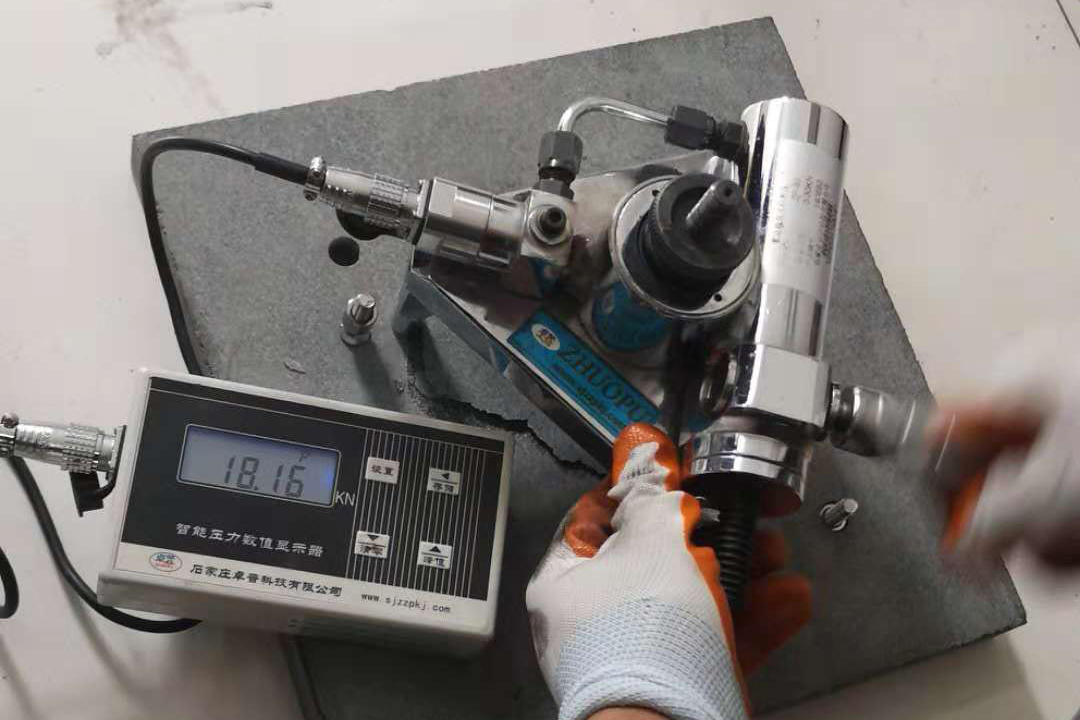
Figure 1. Back Bolt Pull-Out Test
Selection of Panel and Back Bolt
Before performing a pull-out test, the back bolt must be selected specifically for the application to ensure the validity of the test. A suitable back bolt can effectively increase the load on the panel and the stability of the overall structure, and even the convenience of installation. We generallyselect the back bolt according to the panel's material, size, thickness, and other specific characteristicsIn conventional panel pull-out tests, the failure mode is mostly cone failure, at which point the load on the back bolt can reach a relatively good level. However, to achieve cone failure, certain requirements must be met during the test regarding the installation position and edge distance of the panel and back bolt:
① Back bolt drilling edge distance: ≥5 cm, and ≥3 times the panel thickness & ≤1/5 of the total side length
② Back bolt embedment depth: ≥1/2 the panel thickness & ≤2/3 the panel thickness
In a pull-out test, generally only one back bolt is used per panel for the experiment. From the two requirements above, it can be seen that installing the back bolt at the center of the panel is more appropriate, and both the width and thickness of the panel should not be too small.
What Type of Panel Do Suppliers Choose?
Back bolts of the same specification at the same embedment depth perform differently on different panels; on some hard panels in particular, the load capacity is very high — for example, China Black granite, which has very high hardness. The test data suppliers obtain using such panels looks very impressive, and the pull-out force at panel cone failure can even exceed 10 kN.
Therefore, it is inevitable that suppliers choose hard panels as test panels. However, given the considerable variation among panels, the data provided by suppliers can only serve as a reference.
Solutions Matter More
This point is related to the back bolt selection discussed earlier. There are many types of panels on the market, but the range of back bolts that any one manufacturer can offer is limited; moreover, some of these manufacturers have only a superficial understanding of back bolt technology, so it is naturally difficult for them to select the appropriate back bolt for a given panel.
In fact, the solution is very important: a good back bolt can better bring out the performance of the panel and can also reduce construction difficulty and losses. Take sandstone as an example: its material is very soft, and specially processed sandstone is very expensive. When using a standard hammer-in back bolt, the panel breakage rate during hammer-in installation is very high; when using a screw-in back bolt, the installed back bolt may be easily pulled out, giving unsatisfactory load performance. In this case, it is necessary to use ananti-loosening back boltIn addition, some special stones such as travertine also require the use of anti-loosening back bolts for installation. To push their own back bolts, some suppliers do not tell customers the relevant details, resulting in large-scale panel detachment later on; this raises serious safety concerns and is truly dishonest.
Purchasers can fully use the design load values provided in the technical data to conduct on-site factory inspections, asking the back bolt manufacturer on site to perform a pull-out test to determine the bolt's suitability for the panel; they can also learn how to perform a pull-out test in the process.