

Many manufacturers on the market produce injection anchoring adhesive, and many have passed grade A adhesive certification. But until you compare, you get a surprise—did you know that grade A adhesives also vary in quality?
Standards for grade A adhesive
The author reviewed multiple national standards and found that two of them mention standards for grade A adhesive. GB 50728-2011 'Technical Code for Safety Appraisal of Structural Strengthening Materials' stipulates:
4.2.2 For room-temperature-curing structural adhesive with concrete as the substrate, its safety appraisal shall include basic performance appraisal, long-term service performance appraisal, and resistance to medium erosion appraisal. When conducting the appraisal, the following provisions of this section shall be observed:
1 The basic performance of structural adhesive shall comply with the requirements of Table 4.2.2-1, Table 4.2.2-2, or Table 4.2.2-3, respectively;
Table 4.2.2-3 Basic performance appraisal requirements for structural adhesive used for anchoring with concrete as the substrate
Inspection item | Inspection conditions | Appraisal qualification index | ||||
IClass adhesive | IIClass adhesive | IIIClass adhesive | ||||
AGrade | B Grade | |||||
Adhesive properties | Splitting tensile strength (MPa) | Tested at (23±2)℃ and (50±5)% RH at a loading rate of 2 mm/min | ≥8.5 | ≥7.0 | ≥10 | ≥12 |
Flexural strength (MPa) | ≥50 | ≥40 | ≥10 | ≥12 | ||
and shall not fail in a brittle, fragmented manner | ||||||
Compressive strength (MPa) | ≥60 | |||||
Bonding ability | Steel-to-steel tensile shear strength (MPa) | Standard value | (23±2)℃、(50±5)%RH | ≥10 | ≥8 | ≥12 |
Average value | (60±2)℃、10min | ≥11 | ≥9 | |||
(95±2)℃、10min | ≥11 | — | ||||
(125±3)℃、10min | ≥10 | |||||
(-45±2)℃、30min | ≥12 | ≥10 | ≥13 | |||
Bond strength between ribbed steel bar (or full threaded rod) and concrete under confined pull-out conditions | (23±2)℃、(50±5)%RH | C30 | ≥11 | ≥8.5 | ≥11 | ≥12 |
Φ25 | ||||||
l=150 | ||||||
C60 | ≥17 | ≥14 | ≥17 | ≥18 | ||
Φ25 | ||||||
l=125 | ||||||
Steel-to-steel T-impact peeling length (mm) | (23±2)℃、(50±5)%RH | ≤25 | ≤40 | ≤20 | ||
Heat deflection temperature (℃) | Method B using a bending stress of 0.45 MPa | ≥65 | ≥60 | ≥100 | ≥130 | |
Non-volatile matter content (%) | (105±2)℃、(180±5)min | ≥99 |
In addition, injection anchoring adhesives are all organic anchoring adhesives. According to clause 5.1 of JG/T 340-2011 'Anchoring Adhesive for Concrete Structure Engineering':
The requirements for organic anchoring adhesives shall comply with the provisions of Table 1:
Table 1 Requirements for organic anchoring adhesives
No. | Item | Requirement | ||||
AGrade adhesive | BGrade adhesive | |||||
1 | Appearance quality | No separation, agglomeration, or sedimentation | ||||
2 | Sag flow / min | No dripping, ≤10 | ||||
3 | Pot life / min | Fast-setting type | 10~25 | |||
Non-fast-setting type | 25~100 | |||||
4 | Service temperature range | Meet the service temperature range stated in the product specification | ||||
5 | Ethylenediamine content in the curing agent / % | ≤0.1 | ||||
6 | Non-volatile matter content / % | ≥99 | ||||
7 | Bonding performance | Steel-to-steel tensile shear strength standard value / MPa | ≥16.0 | ≥13.0 | ||
Bond strength between ribbed steel bar and concrete under confined pull-out conditions / MPa | C30Concrete | ≥11.0 | ≥8.5 | |||
C60Concrete | ≥17.0 | ≥14.0 | ||||
8 | Durability | Resistance to damp-heat aging, reduction rate of steel-to-steel tensile shear strength standard value / % | ≤10 | ≤15 | ||
Freeze-thaw resistance, reduction rate of steel-to-steel tensile shear strength standard value a / % | ≤5 | |||||
Fatigue test b / 10,000 cycles | ≥200 | — | ||||
aThis item is tested for anchoring adhesives used in cold and severe cold regions and where required by the user. bThis item is tested for anchoring adhesives used in railway engineering, bridge engineering, and where required by the user. | ||||||
The above are the basic performance test items for injection anchoring adhesive. However, the author examined two standards and found certain differences between them, but the testing standard used by third-party testing institutions is GB 50728-2011 'Technical Code for Safety Appraisal of Structural Strengthening Materials'.
Comparison of different grade A adhesives
Here, two injection anchoring adhesives available on the market are taken as examples to compare the differences in their grade A adhesive reports.
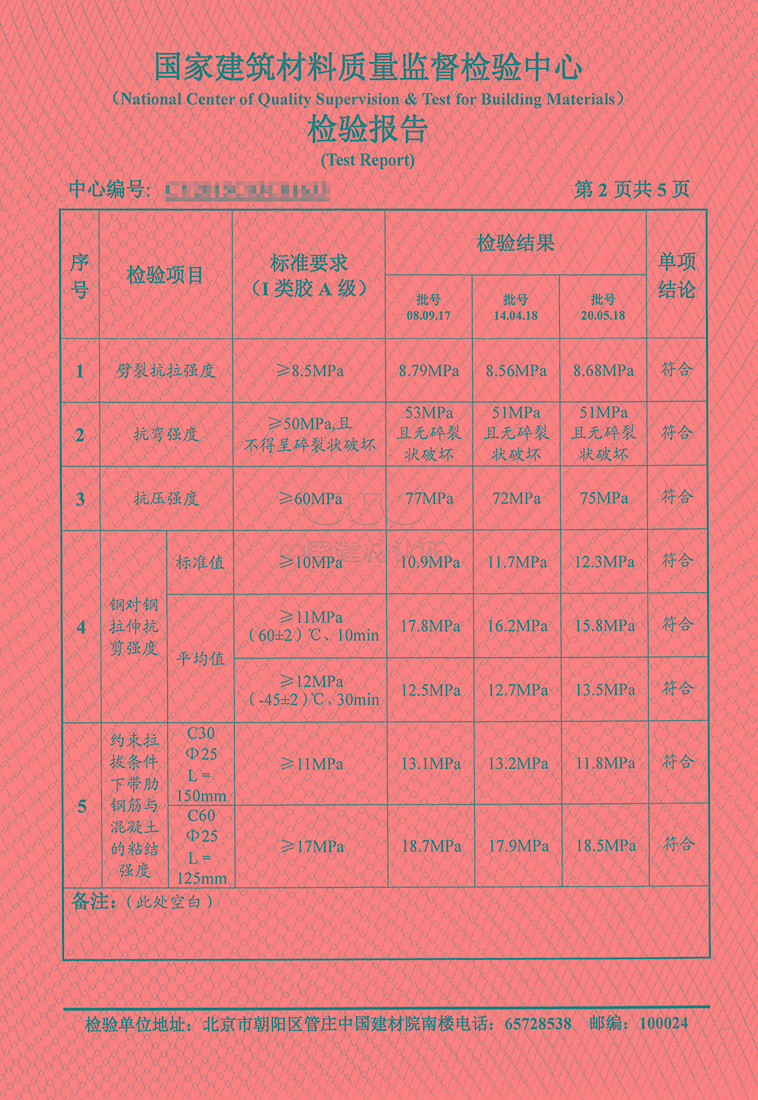
Figure 1. Test report of adhesive from an imported brand A (remove upon request)
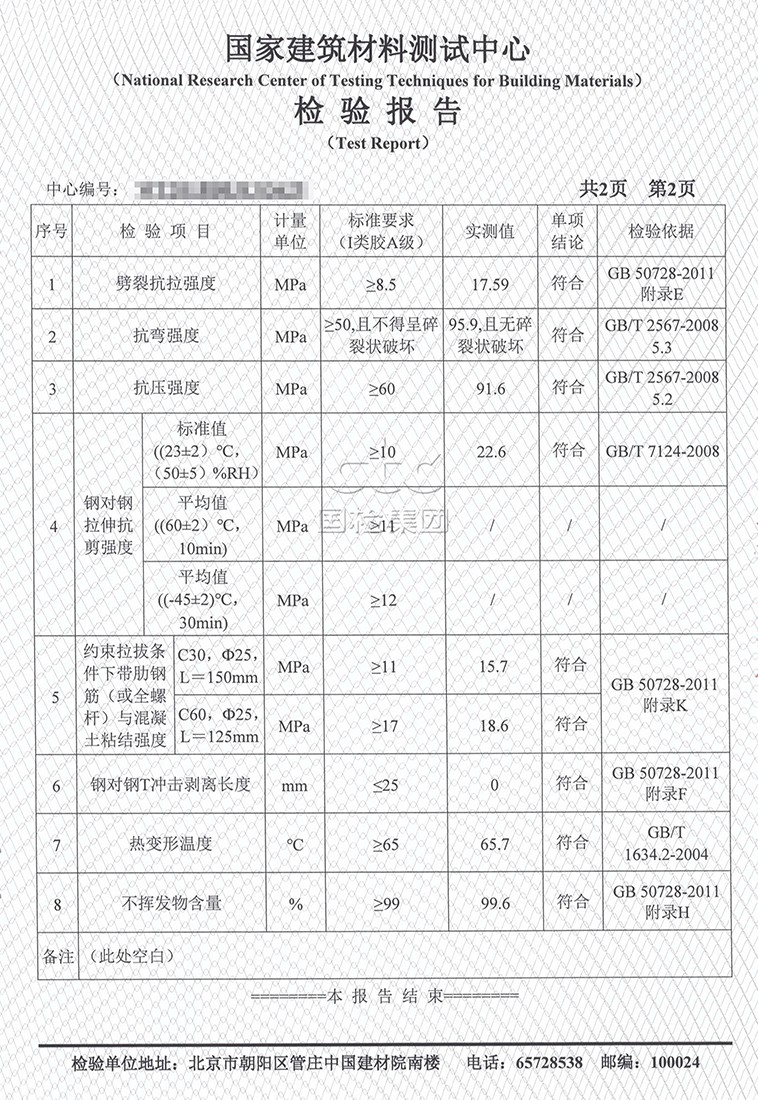
Figure 2. Test report of adhesive from an imported brand B (remove upon request)
A careful comparison of the test parameters of the two reveals huge differences in results for the same test items, with some results differing by as much as 100%. If you are a designer, you can compare the parameters in various adhesive test reports to determine the overall performance of the adhesive.
Other tests for injection anchoring adhesive
In fact,grade A adhesive is only one basic test for injection anchoring adhesive, and GB 50728-2011 'Technical Code for Safety Appraisal of Structural Strengthening Materials' also has the following standards:
2 The appraisal of long-term service performance of structural adhesive shall comply with the following requirements in Table 4.2.2-4:
1) Structural adhesive with a design service life of 30 years shall pass the damp-heat aging resistance test;
2) Structural adhesive with a design service life of 50 years shall pass both the damp-heat aging resistance test and the long-term stress resistance test;
3) Structural adhesive subjected to dynamic loads shall pass the fatigue resistance test;
4) Anchoring adhesive used in cold regions shall pass the freeze-thaw resistance test.
3 The resistance of structural adhesive to medium erosion shall comply with the requirements of Table 4.2.2-5.
4.2.2-4 Standard for appraisal of long-term service performance of structural adhesive with concrete as the substrate
Test item | Inspection conditions | Appraisal qualification index | ||
IClass adhesive | IIClass adhesive | IIIClass adhesive | ||
AGrade | BGrade | |||
Resistance to environmental action | Resistance to damp-heat aging | After aging at 50℃ and 95% RH for 90 d (60 d for grade B adhesive), cool to room temperature and conduct a steel-to-steel tensile shear test | Compared with short-term test results at room temperature, the reduction rate of its shear strength (%): | |
≤12 | ≤18 | ≤10 | ≤12 | |
Resistance to heat aging | After aging for 30 d in the following temperature environments, conduct steel-to-steel tensile shear tests at the same temperature | Compared with 10 min short-term test results at the same temperature, the reduction rate of its shear strength: | ||
(80±2)℃ | ≤5 | Not required | — | — |
(95±2)℃ | — | — | ≤5 | — |
(125±3)℃ | — | — | — | ≤5 |
Freeze-thaw resistance | At -25℃⇋35℃freeze-thaw cycling temperature, with each cycle lasting 8 h; after 50 cycles, conduct a steel-to-steel tensile shear test at room temperature | Compared with short-term test results at room temperature, the reduction rate of its shear strength shall be no more than 5% | ||
Resistance to stress | Resistance to long-term stress | Subjected to a 4.0 MPa shear stress continuously for 210 d in an environment of (23±2)℃ and (50±5)% RH | No failure in steel-to-steel tensile shear over time, and the creep deformation value is less than 0.4 mm | |
Resistance to fatigue stress | At room temperature, conduct steel-to-steel tensile shear tests under a fatigue load with a frequency of 5 Hz, a stress ratio of 5:1.5, and a maximum stress of 4.0 MPa | After 2×10⁶ cycles of constant-amplitude sinusoidal fatigue loading, the specimen does not fail |
Note: If, before applying for safety appraisal, relevant research institutions have been entrusted to complete verification tests and conformity assessment of the long-term stress resistance of this brand of structural adhesive, and the assessment report has been reviewed by the safety appraisal institution, this test may be waived and a wedge rapid determination (Appendix C) performed instead.
Table 4.2.2-5 Appraisal standard for resistance of structural adhesive to medium erosion with concrete as the substrate
Performance to be inspected | Medium environment and treatment requirements | Appraisal qualification index | |
Strength reduction rate compared with the control group (%) | Appearance quality requirements after treatment | ||
Resistance to salt spray | 5%NaClSolution; spray pressure 0.08 MPa; test temperature (35±2)℃; spray once every 0.5 h, each time for 0.5 h; the salt spray should settle freely on the specimen; duration of action: 90 d for grade A adhesive and type II and III adhesives; 60 d for grade B adhesive; upon expiry, conduct a steel-to-steel tensile shear strength test | ≤5 | No cracks or debonding allowed |
Resistance to seawater immersion (only for underwater structural adhesive) | Seawater or artificial seawater; test temperature (35±2)℃; immersion time: 90 d for grade A adhesive; 60 d for grade B adhesive; upon expiry, conduct a steel-to-steel tensile shear strength test | ≤7 | No cracks or debonding allowed |
Resistance to alkaline media | CaSaturated Ca(OH)2 solution; test temperature (35±2)℃; immersion time: 60 d for grade A adhesive and type II and III adhesives; 45 d for grade B adhesive; upon expiry, conduct a steel-to-concrete tensile bond strength test | No reduction, and failure is in the concrete | No cracks, peeling, or blistering allowed |
Resistance to acidic media | 5%H2SO4Solution; test temperature (35±2)℃; immersion time: 30 d for all types of adhesive; upon expiry, conduct a steel-to-concrete tensile bond strength test | Concrete failure | No cracks or debonding allowed |
According to the above description,Injection anchoring adhesive may also need tests for resistance to damp-heat aging, resistance to long-term stress, fatigue resistance, and freeze-thaw resistance; some special working conditions may even require testing of resistance to medium erosion. These working conditions need to be considered when designing a project; grade A adhesive is not the only standard.