

The author once answered the company phone for a period of time due to work needs and found that many people making inquiries did not even knowClassification of chemical anchorsthe specifications and models of chemical anchors, let alone the installation parameters. When encountering such inquiries, we are at a loss. In fact, purchasing personnel should have a certain understanding of the product so that they can obtain the right product at a reasonable price and with proper knowledge.
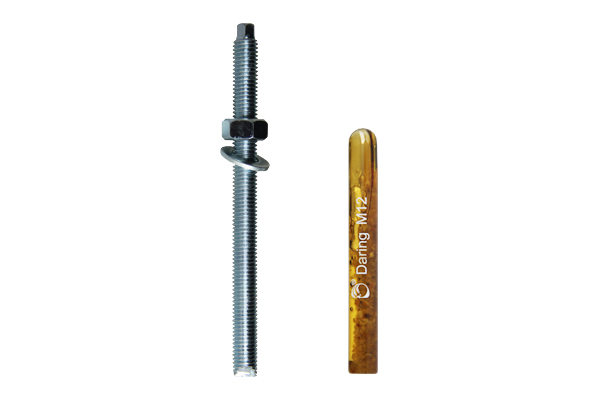
Figure 1 High-strength chemical anchor
Specifications and models of high-strength chemical anchors
Generally, manufacturers produce high-strength chemical anchors according to national standards, and the corresponding specifications and models also follow certain conventions. To avoid difficulties in inventory turnover, most manufacturers do not stock high-strength chemical anchors above M20; as for the small M8 size, they rarely or simply do not stock it. Large-size anchors are themselves shipped in small quantities at a time, so purchasers often encounter problems when placing a single order. For example, most manufacturers consider it time-consuming to adjust the production line for small quantities and simply will not accept such orders; some manufacturers can accept them but at relatively high prices. Taking into account the problems purchasers of large-size anchors may encounter, Daring generally keeps a small stock of M24 and M30 specifications. Of course, the stocked models are all national standard models (the models listed in the table below). Some customers ask about non-standard models; basically no manufacturer stocks non-standard sizes.
Table 1. Specifications, models, and parameters of high-strength chemical anchors
Product model | Drill hole diameter (mm) | Drill hole depth (mm) | Maximum anchoring thickness (mm) | Minimum base material thickness (mm) | Total threaded rod length (mm) |
*M8×110 | 10 | 80 | 15 | 140 | 110 |
M10×130 | 12 | 90 | 20 | 160 | 130 |
M12×160 | 14 | 110 | 25 | 210 | 160 |
M16×190 | 18 | 125 | 35 | 210 | 190 |
M20×260 | 25 | 170 | 65 | 340 | 260 |
*M24×300 | 28 | 210 | 65 | 370 | 300 |
*M30×380 | 35 | 270 | 70 | 540 | 380 |
P.S. Product models marked with * are custom products, and Daring has a small amount in stock.
Taking the M12×160 specification as an example, M12 represents the threaded rod diameter and 160 (mm) represents the total rod length; other parameters are not shown in the product model. However, some customers may need non-standard models. Because their processing is troublesome and the lead time is longer, we generally first confirm the working conditions with the customer and only consider customizing a non-standard model after determining that a standard model cannot be used. Daring once customized M56×1500 high-strength chemical anchors for a nuclear power project in China.
Simple selection of chemical anchors
After understanding the specifications and models, there are three more points to understand: material, grade, and surface treatment. Generally, material and grade are related to some extent, but not absolutely. For example, 35# steel can be made into a class 5.8 anchor or a class 8.8 anchor, provided heat treatment is done properly; however, heat treatment is often difficult to do well (not in an owned factory and on a large scale), so the probability of problems is not small. Daring mostly uses 40Cr steel and 45# steel for class 8.8 anchors and 35# steel for class 5.8 anchors. In addition, carbon steel must be surface-treated. The surface treatments recognized by anchoring system standards are hot-dip galvanizing and electrogalvanizing (cold galvanizing), and most manufacturers use these two treatments. The coating thickness of hot-dip galvanizing can reach 40-100 um, while electrogalvanizing is only 5-10 um, so the two differ greatly in weather resistance.
The main factors to consider in selection are as follows:
1) Weather resistance, which is very important. Many working conditions place relatively high demands on the corrosion resistance of anchors, such as subways, utility tunnels, and other relatively humid environments. In these cases, hot-dip galvanized material is usually the baseline, and even the more corrosion-resistant 304/316 material may be used. Requirements in some coastal areas are even stricter: in places with a high Cl ion content, such as underwater in seawater, 304 material will corrode quickly, and even 316 material may not escape. In such cases, apart from using more corrosion-resistant materials (which are very expensive and rarely available domestically), the only option is to apply a special coating to the anchor surface.
2) Mechanical properties. The overall building structure requires strict control to be safe, and designers will provide corresponding tensile and shear design values during design. We can select the anchor specification and model based on the design values, which can be provided by the chemical anchor manufacturer and then confirmed by on-site tests.
3) Other factors. For example, some high-end projects or earthquake-prone areas will consider the seismic performance of anchors. In addition, we recommend that designers first understand the specifications of high-strength chemical anchors when designing a project and try to design using national standard specifications; if non-standard anchors must be used, the quantity should be ensured, otherwise various problems may arise when placing orders later. There are also some construction issues,
The selection method mentioned here is not specific to one type of anchor; other anchors can be selected in the same way. However, for specific selection it is best to consult the manufacturer, or even better, have the manufacturer provide a more reasonable solution.