

The Anka anchor, also known as the wedge anchor, has an extremely wide range of applications; in fact, its usage abroad is even greater than that of chemical anchors. A large number of manufacturers in China produce Anka anchors, and their production process is relatively mature. Even so, the actual pull-out load of Anka anchors of the same specification, such as M12, still varies greatly, generally ranging from 15 kN+ to around 50 kN.
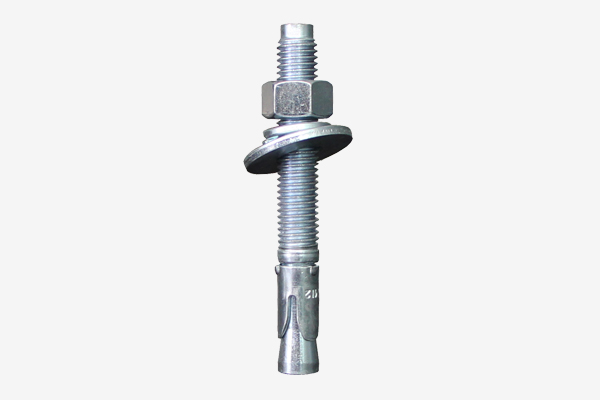
Figure 1 Anka anchor
The load capacity of an Anka anchor is closely related to its own dimensional tolerances and also largely to its installation. Compared with other anchors, the installation of Anka anchors is relatively complicated. Its installation steps are as follows:
(1) Use a straight-hole drill bit to drill a hole of the corresponding diameter and depth;
(2) Use a blower aimed at the hole to blow out dust until no dust comes out of the hole;
(3) Drive the Anka anchor into the hole;
(4) Tighten the nut so that the expansion segments expand to complete the anchoring.
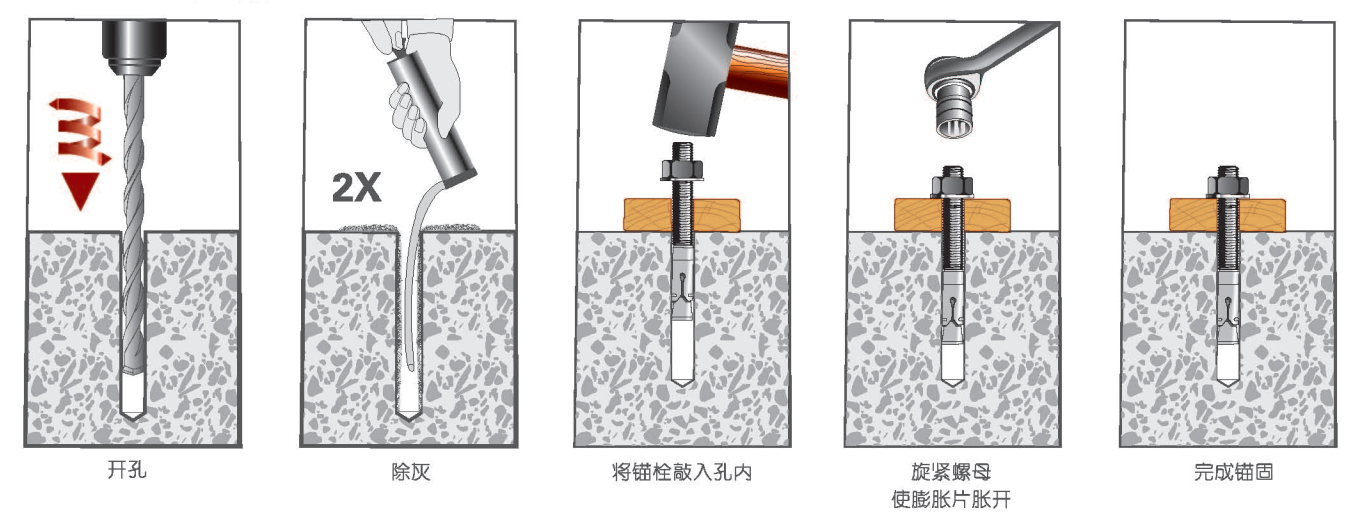
Figure 2 Anka anchor installation steps
P.S. For drill hole diameter and depth, refer to theAnka anchor introduction on our official website. It is worth noting that striking an Anka anchor may deform its threaded rod, so there is no need to remove the flat washer, spring washer, or nut before driving in the anchor; otherwise, installation problems may occur. The expansion segments only expand when the nut is tightened. If this step is omitted during construction, the Anka anchor can be pulled directly out during a pull-out test, with a pull-out load below 10 kN.