

Generally, in high-end commercial buildings or office buildings, non-glass curtain walls are stone curtain walls. Glass curtain walls have a difficult-to-solve light pollution problem, so stone curtain walls are likely to become more common in the future. There are countless types of stone used on exterior walls, and each has different characteristics such as hardness, texture, and luster. Some distinctive buildings may need to select stone for dry-hung cladding according to local conditions, and in that case we can only select the corresponding back bolt specification and model based on the stone.
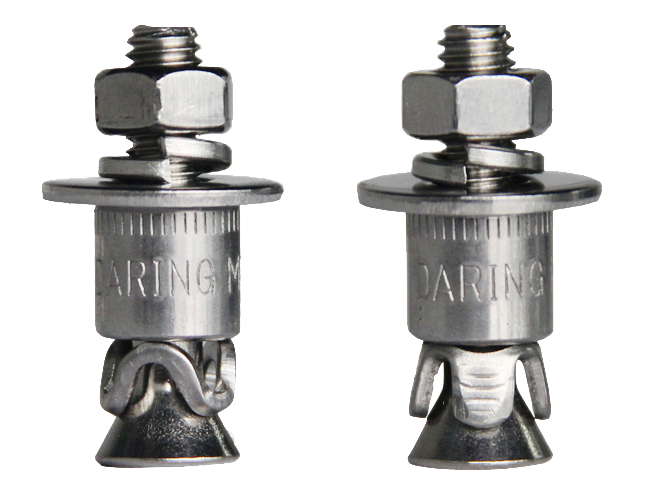
Figure 1 Hammer-in back bolt
The thickness of dry-hung stone is generally around 25 mm to 50 mm; of course, there are cases with greater thickness. For example, we have seen projects using 100 mm thick stone, with some local sections reaching 200 mm. For these special working conditions, we need to plan each case individually.
As with how to select back bolt specifications for dry-hung ceramic tile, we need todetermine the embedment depth of the back bolt based on the principle that it is 1/2 to 2/3 of the stone thickness, and then select an available or custom-made back bolt specification based on the embedment depth. The stone back bolts we often refer to are mostly hammer-in back bolts; here we take the hammer-in back bolt as an example for model recommendation:
Table 1. Recommended back bolt models for dry-hung stone
Panel thickness | Embedment depth | Recommended back bolt model |
25-30mm | 15mm | M6×15/M8×15 |
31-40mm | 20mm | M6×20/M8×20 |
41-50mm | 25mm | M6×25/M8×25 |
51-60mm | 30mm | M6×30/M8×30 |
61-70mm | 35mm | M8×35 |
71-80mm | 40mm | M8×40 |
Generally, M6×16/M8×15 are fairly conventional back bolt models; all others must be custom-made. It is worth noting that each back bolt model requires a matching back bolt drilling bit, and the drilling depth of custom bits generally cannot exceed 50 mm. However,when the stone thickness reaches about 80 mm or more, undercut anchors can be used for anchoring, and their load-bearing performance can even be better than that of back bolts.
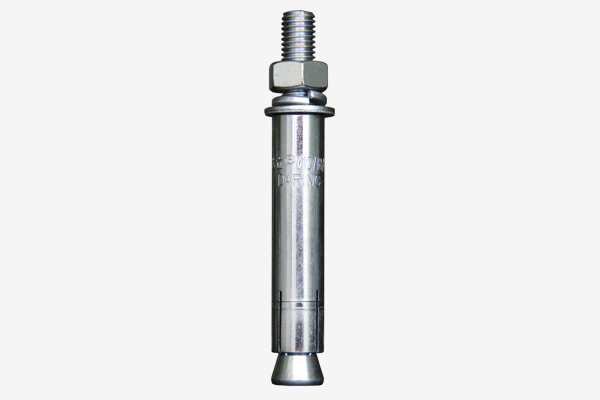
Figure 2 Undercut anchor
Back bolts are available in 304 and 316 materials and can be selected according to project requirements. Except in some strongly corrosive environments (such as those containing large amounts of Cl ions), 304 back bolts are generally sufficient.