

There is an old saying, "Never fear that the waves are high; fear only that the oars are uneven," meaning that only when people pull together can they face the storm without fear. To put it bluntly, the building materials market is huge, but quality is highly uneven. Most merchants in this industry seem to have lost their conscience, otherwise they would not produce so much metal junk; and some contractors seem to have lost theirs too, otherwise they would not buy these non-compliant products for construction. This is largely why Chinese manufacturing cannot become strong: there are simply too many unscrupulous practices.
Getting back to the point, good products still have a market; however, for people who do not understand chemical anchors, even being willing to pay a higher price does not necessarily mean they can buy a good product. Of course, chemical anchors are basically well known to construction companies, and many people know a great deal about their performance. Here we simply offer methods for identifying good versus bad chemical anchors for those who want to learn.
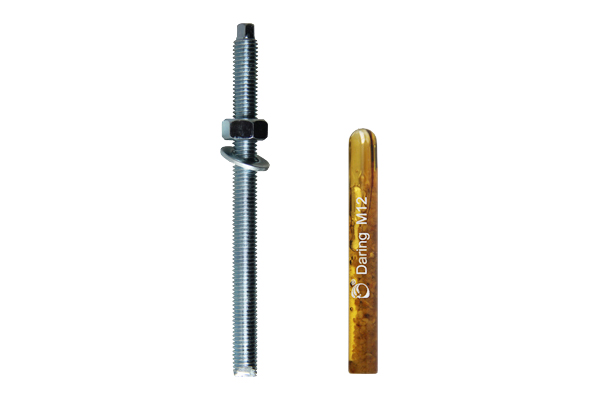
Figure 1 High-strength chemical anchor
Testing mechanical properties with a pull-out tester
Using a pull-out tester to measure mechanical properties is the simplest and a relatively scientific method. Generally, one or more groups from the same batch can be tested at once. If the mechanical properties meet the standard and are relatively stable, and the coating thickness meets the requirements, this proves that this brand and batch of chemical anchors is relatively reliable. To be completely sure, every batch of chemical anchors should be sampled and inspected. This type of testing is suitable for chemical anchor manufacturers; now Daring carries out sampling inspection of a corresponding number of products for every batch before shipment.
Third-party commissioned testing
Third-party commissioned testing means that a company commissions an authoritative third-party organization (such as the China Building Materials Academy) to carry out testing in the company's name. The test method is sample submission, and the test items may include tension and shear, material properties, fire resistance, and so on. This approach may seem more authoritative than the previous one, but because sample submission itself involves a certain uncertainty and testing takes a long time, it is difficult to test every batch. Therefore, this method is less reliable than the previous one. However, some projects have special requirements that leave no choice but to use this method.
A simple side-by-side comparison
We know that in the building materials industry, brands are selected through tendering, and submitting and sealing samples is a necessary step. In many cases, a simple comparison is all it takes to determine which brand's product is better.
① By measuring dimensions. Some manufacturers deliberately reduce anchor dimensions to save material. We can simply learn the dimensions for the corresponding specification and then measure, directly eliminating such inferior brands that even cut corners on size.
② By observing color, finish, and so on. Products made by reputable manufacturers have considerably better surface finish than those from small workshops; after obtaining samples from three or four suppliers, a simple visual comparison will show which product looks better. The quality of galvanizing on carbon steel products determines their color; generally, hot-dip galvanizing shows greater color variation than electro-galvanizing. Stainless steel products, of course, can be judged directly by overall workmanship.
③ By a simple thread-striking test. We know carbon steel products are graded; taking the high-strength chemical anchor as an example, the market generally offers three classes—4.8, 5.8, and 8.8—and the higher the class, the greater the hardness. When using anchors, a higher class is not always better. Therefore, after selecting a class, you can judge which brand's product is better by striking the threads against each other: harder products are less likely to show chips on the threads and are relatively better in quality. Of course, this method can only serve as a preliminary judgment, because some manufacturers may submit high-class samples when bidding but supply lower-class products on delivery.
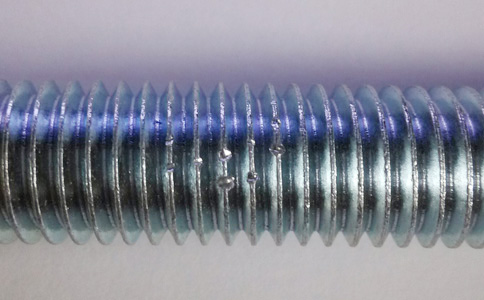
Figure 2 Chemical anchor with damaged threads
④ Through the manufacturer's qualifications and the product's commissioned test reports. These two things can reflect a manufacturer's strength to a certain extent, especially on large projects where requirements for building materials are strict and test reports for some products are necessary; this can also help screen out certain brands.
In short, the quality of a chemical anchor involves many aspects, such as flatness, coating thickness, and stability, but mechanical properties are undoubtedly the most important. If you are planning to purchase chemical anchors in large quantities, you should understand these methods and try to use scientific methods to assess their quality.