

Anchoring adhesives on the market are mainly divided into two types: injection anchoring adhesive and pail-packaged anchoring adhesive. The latter is used dozens of times more, or even far more, than the former, mainly because pail-packaged adhesive is cheaper. Generally, pail-packaged anchoring adhesive is mostly used for post-installed rebar anchorage, while injection anchoring adhesive is mostly used for chemical anchor products and large-diameter post-installed rebar anchorage.
Injection anchoring adhesive is mostly of the mechanical injection type, divided into two cartridges; a dedicated adhesive gun extrudes the adhesive from both cartridges and mixes it uniformly through a mixing nozzle. With this type of adhesive, once the initial material at the nozzle has been dispensed, very uniform mixing is guaranteed; for specific usage, refer to the instructions for the reverse-cone chemical anchor. Pail-packaged anchoring adhesive consists of two components, A and B, which are mixed with a dedicated mixer to ensure uniform mixing. However, owing to on-site construction conditions, the mixing result is often unsatisfactory.
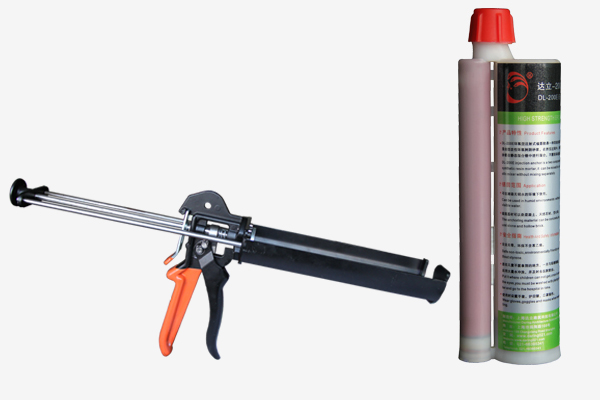
Figure 1. Injection anchoring adhesive
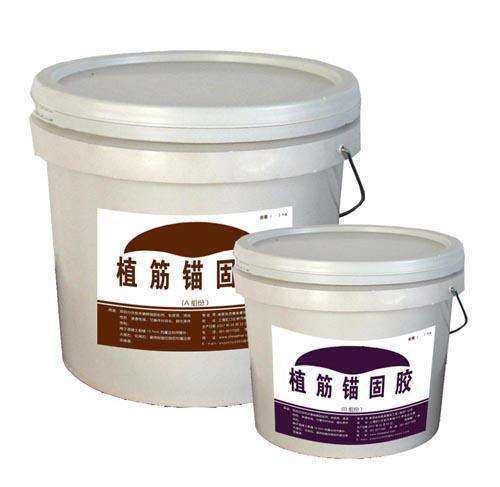
Figure 2. Pail-packaged two-component anchoring adhesive
The class A adhesive standard is an important dividing line
Since both are anchoring adhesives, what is the difference? Class A adhesive is probably the biggest difference: injection anchoring adhesives are generally produced to formulations that meet the class A standard, while pail-packaged anchoring adhesives basically cannot meet the class A standard. The performance of injection anchoring adhesives that meet the class A standard is considerably better than that of pail-packaged adhesives. GB 50367-2013 'Code for Design of Strengthening Concrete Structure' contains the following provision:
15.1.5 The adhesive used for post-installed rebar shall be a modified epoxy structural adhesive or a modified vinyl ester structural adhesive. Where the diameter of the post-installed rebar is greater than 22 mm, a class A adhesive shall be used. The quality and performance of the anchoring adhesive shall comply with the provisions of Chapter 4 of this code.
Obviously,when the diameter of the post-installed rebar is large (greater than 22 mm), an injection anchoring adhesive meeting the class A standard must be used.In actual construction, cases where the post-installed rebar diameter exceeds 22 mm are not uncommon.
It is worth noting that injection anchoring adhesives meeting the class A standard also vary in quality. If you know the field, you can judge their performance by comparing the manufacturer's class A test report with the class A standard; the performance of some manufacturers' injection anchoring adhesives only slightly exceeds the class A standard.
Market disorder
It is no exaggeration to say that the construction industry is one of the most disorderly industries; although various construction codes have been issued one after another, the enforcement rate has always been low. JGJ145-2013 'Technical Specification for Post-Installed Anchorage of Concrete Structures' contains the following clause:
3.3.4 The anchoring adhesive for chemical anchors shall be selected as cartridge type or mechanical injection type according to the applicable object and site conditions. The performance of mechanical injection anchoring adhesive shall comply with the relevant provisions of the current industry standard 'Anchoring Adhesive for Concrete Structure Engineering' JG/T 340. The anchoring adhesive for chemical anchors shall be a modified epoxy resin or modified vinyl ester material.
In other words,reverse-cone chemical anchors must be used with injection anchoring adhesive, but on site, construction often does whatever saves the most money. For example, in some special areas where ordinary chemical anchors are prohibited (such as Zhejiang, which prohibits ordinary chemical anchors on curtain walls), ordinary chemical anchors are still used in place of reverse-cone anchors, and pail-packaged anchoring adhesive is even used wholesale in place of injection anchoring adhesive. How can safety performance be ensured with such construction?
Even setting that aside, pail-packaged anchoring adhesive comes in large quantities: the combined weight of the two components is generally more than 10 kg, even up to 30 kg, but it is not advisable to mix more than 5 kg at a time, so uneven mixing often occurs. Moreover,mixing pail-packaged anchoring adhesive requires a dedicated area and a power supply, and also takes a good deal of time on site; counting labor costs, it may not necessarily be cheaper than injection anchoring adhesive. Sometimes, when work at height is required, pail-packaged adhesive is also very inconvenient.