

Many people do not understand the difference between high-strength chemical anchors (i.e., ordinary chemical anchors) and reverse-cone chemical anchors, and do not know when to use a high-strength chemical anchor and when to use a reverse-cone anchor. This article analyzes the differences between the two from various perspectives, so that after reading it you can decide which product to use.
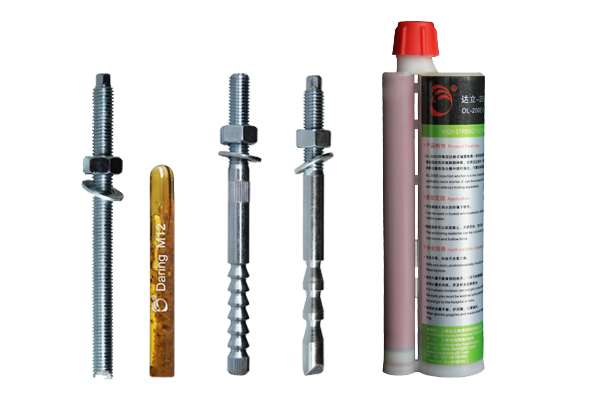
Figure 1 Chemical anchor
Compliance with codes is the principle
After understanding the classification and applications of chemical anchors, we can roughly understand the differences between the two; here we will explain the rules for their use in more detail.
Some provinces, such as Zhejiang, have prohibited the use of high-strength chemical anchors in building curtain wall projects, in which case only reverse-cone chemical anchors can be used as a substitute.
Moreover, codes explicitly stipulate that ordinary chemical anchors must not be used in cracked concrete. Designers need to consider the type of concrete when designing a project; in cracked concrete areas, only a combination of reverse-cone anchors and undercut mechanical anchors may be used to anchor structural components.
In both of these situations, only reverse-cone chemical anchors can be used.
Must meet design requirements
It is generally difficult to find an M8 reverse-cone anchor on the market; if you need an M8 chemical anchor, you will usually have to choose a high-strength chemical anchor.
If you have high requirements for mechanical properties and need large-size anchors, a reverse-cone anchor may be more suitable. Let us give a simple example: taking an M12 × 160 high-strength chemical anchor and a reverse-cone anchor, in an ultimate tensile test on C30 non-cracked concrete, both result in the threaded rod breaking; at this point the load capacity of the two anchors of the same class is almost identical. But if both anchors are of M24 × 300 specification, the tensile test results will both be adhesive failure, with the anchor pulled straight out; in this case the tensile force of the reverse-cone anchor may be about 20% higher than that of the high-strength chemical anchor. In other words, the reverse-cone anchor using injected anchoring adhesive has better ultimate tensile capacity. At this point the pull-out resistance of the high-strength chemical anchor may just fail to meet the requirement, in which case only a reverse-cone anchor can be used. As for the mechanical properties of the two, you can ask the manufacturer to provide the corresponding test reports and then determine from the values in the reports whether they meet the project requirements.
Special treatment for projects with schedule constraints
When the schedule of a project has to be shortened for various complex reasons, we can consider choosing products that take less time to install.
Here are the setting times of resin capsules and injection anchoring adhesive:
Table 1. Setting time of resin capsules
Substrate temperature | Hardening time |
-5℃—0℃ | 5 hours |
0℃—10℃ | 1 hour |
10℃—20℃ | 30 minutes |
>20℃ | 20 minutes |
Table 2. Setting time of injection anchoring adhesive
Substrate temperature | Curing time |
-10℃—-5℃ | 8 days |
-5℃—0℃ | 7 days |
0℃—10℃ | 6 days |
10℃—25℃ | 4 days |
25℃—40℃ | 2 days |
≥40℃ | 1 day |
From the two tables above it can be seen that resin capsules used with chemical anchors have a very short curing time compared with the injection anchoring adhesive used with reverse-cone anchors, which can effectively shorten construction time.
In addition, referring to the installation steps for high-strength chemical anchors and reverse-cone chemical anchors, it can be seen that chemical anchors are also simpler to install, which is a good choice if you want to save time.
Special considerations for custom products
What we discussed above are all standard-size chemical anchors, but in many cases we encounter all kinds of unusual inquiries—for example, a customer may need an M16 × 1900 or M30 × 500 high-strength chemical anchor. Here we can briefly evaluate the design. Take the M16 × 1900 chemical anchor, for instance: in a tensile test, an M16 chemical anchor generally fails by the threaded rod breaking, in which case an embedment depth of 125 mm is no different from 1250 mm. This is a case of insufficient consideration on the designer's part and also wastes a large sum of money for the company. The M30 × 500 high-strength chemical anchor is different: the rod may have been lengthened for a special purpose (the standard rod length is 380 mm). However, because the embedment is relatively deep, few manufacturers will specially make a resin capsule for an anchor of this length, and even if customized, it would be very expensive. In such cases we would directly advise the user to use injection anchoring adhesive for installation, which saves the manufacturer time and the customer money; moreover, the mechanical properties of a high-strength chemical anchor used with anchoring adhesive are also good, making it a sound solution.
Price has a greater influence
If the issues mentioned above account for only a small proportion, then price is certainly the key chip influencing the direction of the whole market. Generally, high-end projects use reverse-cone anchors, such as rail transit and utility tunnel projects. However, the price difference between the two is roughly a factor of two, so contractors have no reason not to choose the cheaper product for construction, even if they have to take risks. This is the result of cutthroat competition, and it is common practice to win a bid at a low price and then substitute materials and methods. Nevertheless, Daring still hopes the market can become regulated and that more conscientious companies can survive in it.