

As another branch of chemical anchors, reverse-cone chemical anchors are also widely used, mostly for anchoring between concrete and the anchored object in high-end projects. Some provinces have issued relevant codes strictly prohibiting the use of high-strength chemical anchors on curtain walls.
Post-installed embedded parts for building curtain walls shall be selected in accordance with design requirements, using reliable anchors such as undercut mechanical anchors and capsule chemical anchors; ordinary chemical anchors shall not be used. Where capsule chemical anchors are used, the supplier shall provide a high-temperature resistance test report for the chemical anchor.
The above is Clause 4.6 of Zhejiang's Technical Requirements for Building Curtain Wall Safety. As time goes on, more provinces may introduce related policies.
In fact, the installation steps for high-strength chemical anchors are simpler: they are simply used together with a resin capsule. Reverse-cone anchors, on the other hand, need to be used with modified epoxy injection anchoring adhesive.More than half of the anchoring adhesive manufacturers in China cannot solve the problem of leakage in injection anchoring adhesives, which may prevent the two-component adhesive from mixing evenly and affect the bonding performance of the anchoring adhesive. Of course, the adhesive itself also varies in performance, and even among class A adhesives there are good and poor products.
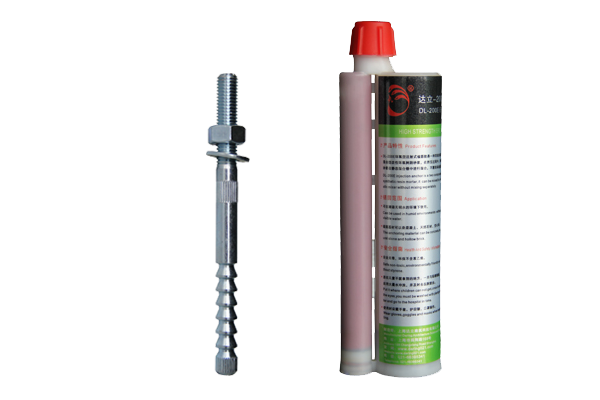
Figure 1. Reverse-cone chemical anchor (left) and modified epoxy injection anchoring adhesive (right)
The installation steps for a reverse-cone chemical anchor are as follows:
(1) Drill a hole of the corresponding diameter and depth according to the product instructions;
(2) Use a dust blower to blow out the hole at least twice;
(3) Use a brush to clean dust from the hole wall at least twice;
(4) Use the dust blower again to blow out the hole until no dust comes out;
(5) Inject the modified epoxy anchoring adhesive;
(6) Screw in the reverse-cone chemical anchor.
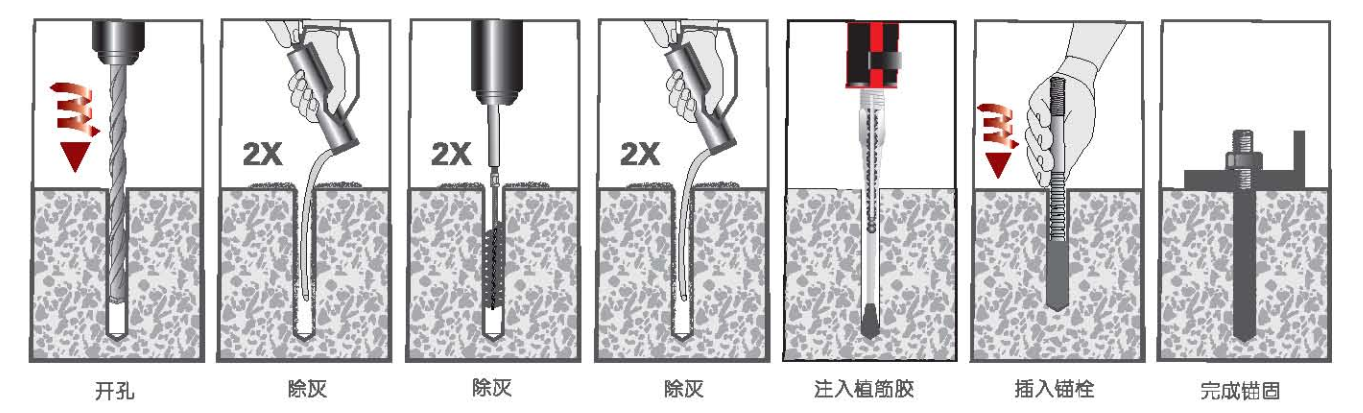
Figure 2. Reverse-cone chemical anchor installation steps
As above, steps (2), (3), and (4) are intended to remove dust adhering inside the hole and on the hole wall, so as to prevent degradation or even failure of the chemical compound's mechanical properties and the resulting hazards. In step (5), a dedicated anchoring adhesive gun is required to inject the adhesive into the hole; installers need to test the adhesive on site in order to use the right amount without waste. There are a few points to note:
(1) The amount of adhesive used should be approximately 1/2 to 2/3 of the hole depth;
(2) The adhesive at the start of the mixing nozzle is not sticky; squeeze it out until the mixed color becomes uniform;
Reference values for the adhesive consumption of reverse-cone chemical anchors are as follows:
Reverse-cone anchor model | Hole diameter (mm) | Embedment depth (mm) | Number of holes per cartridge (390 ml) |
M12×160 | 14 | 110 | 28 |
M16×190 | 18 | 125 | 15 |
M20×260 | 25 | 170 | 6 |
M24×300 | 28 | 210 | 4 |
M30×380 | 35 | 280 | 2 |
P.S. The anchoring adhesive will not cure at temperatures below -10°C.
Since many people are not familiar with the use of anchoring adhesive, a corresponding installation video is provided for reference.