

As a relatively good form of exterior dry-hung cladding, the back-bolt stone curtain wall has always been difficult to popularize; most common stone curtain walls use the slotted method. So what is the reason?
High cost of back-bolt stone curtain walls
The back-bolt method has huge advantages over the slotted method, but the cost of a back-bolt stone curtain wall is very high, and this is the most important factor limiting its widespread adoption.
Let us briefly analyze this. In actual use, a back-bolt stone curtain wall as a whole is dry-hung on horizontal sub-frame members. Depending on the arrangement of the back bolts in the stone, generally two rows of back bolts are used to dry-hang each stone panel, and each row is provided with one horizontal sub-frame member. Taking Figure 1 as an example, each row of stone uses two sub-frame members.
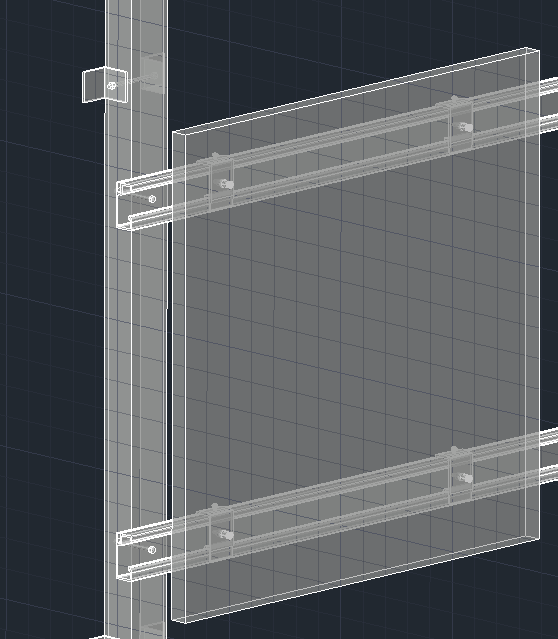
Figure 1. Back-bolt stone curtain wall
A slotted stone curtain wall is different: each stone panel is bonded at the top and bottom with SE combination pendants, so that in fact only one horizontal sub-frame member is needed per row of stone.
At this point we can see that a slotted stone curtain wall saves one horizontal sub-frame member, and SE combination pendants are also relatively cheap compared with twice the number of back bolts and matching pendants. If costs are to be saved, the vast majority of contractors will choose the slotted method where national standards permit it.
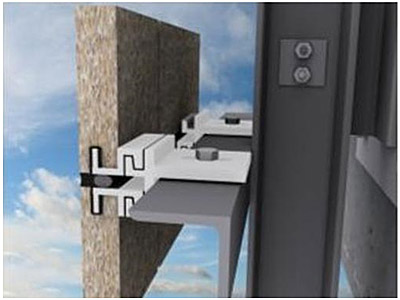
Figure 2. Slotted stone curtain wall
A large share of low-end projects
The '80/20 rule' is a natural law we often speak of, and it applies to curtain wall projects as well. Driven by market forces, low-end projects predominate, reaching 80% or even more. When the overall project budget is relatively low, the more expensive back-bolt stone curtain wall is basically not used—there is no doubt about that.
A market environment of cutthroat competition
Many people do not understand bidding in the construction industry. Under current market conditions, when dozens or even hundreds of companies participate in a tender, 'winning on the lowest price' is the only way most bidders can win. Owners often do not understand many of the small materials, and blindly choosing the lowest-priced bidder can bring irreversible consequences upon themselves. Some unscrupulous contractors (usually curtain wall companies) submit one proposal when bidding but, in order to make a profit, revise the proposal again after winning. This leaves the owner in a passive position, since it is difficult to retender because of the schedule. In fact, owners also have a budget department; if they could gain an in-depth understanding of building materials and other costs, and allow the contractor a reasonable profit, the current situation would not arise.
Of course, in reality it is rarely that simple: there are many strange, hidden relationships in curtain wall bidding, and far too many factors influence the outcome—but they usually come back to 'money'. Sometimes a high-priced bid also results in poor work. The recent incident in Hefei, where several bus stops collapsed under snow and caused deaths, was just such a case; the investigation found that the construction quality was substandard.
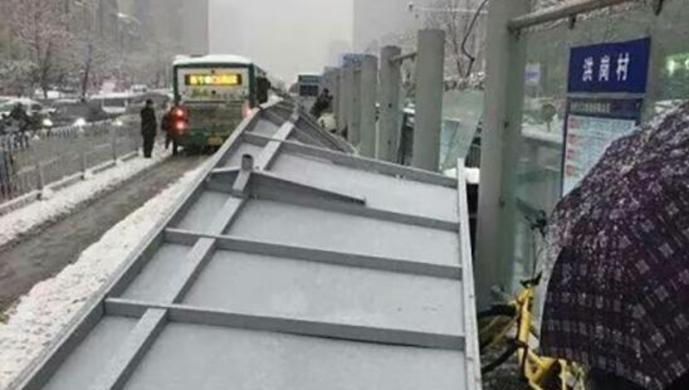
Figure 3. Bus stop shelters collapsed under snow in Hefei
Daring hopes this market will become properly regulated, so that the best outcome is to buy from whichever material supplier can provide quality products. It should not be as it is now, where companies win bids through relationships, low prices, and other forms of cutthroat competition and then cut corners to make money. This is not how a market should work, and our government should also strengthen supervision to ensure construction quality.