

We often hear purchasers discussing anchor classes, and some even once felt that the higher the anchor class, the better. Some manufacturers have accordingly introduced class 10.9 or even class 12.9 anchors to meet this customer 'demand'.
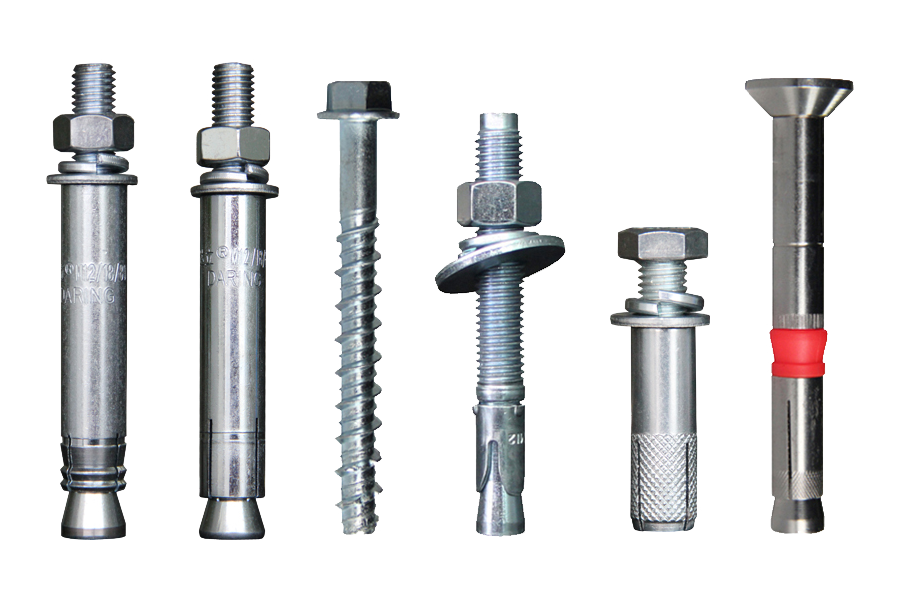
Figure 1. Photos of selected anchors
Definition of anchor classes
The classes we often mention, such as 4.8 and 8.8, represent the performance class of the anchor and are not necessarily related to the raw material. For example, a class 5.8 chemical anchor has a tensile strength of 500 MPa and a yield ratio of 0.8, giving a nominal yield strength of 500 × 0.8 = 400 MPa. Other anchor classes are calculated in a similar way.
However, many people have no concept of the calculation above. Let us briefly go through it. Taking the commonly used M12 chemical anchor as an example, its design tensile value is generally 16–18 kN; with a safety factor of 2.5 (already fairly conservative), its maximum tensile force should be 40–45 kN. A class 5.8 chemical anchor in M12 has an ultimate tensile load capacity of more than 50 kN, which fully meets the requirement, while a class 8.8 anchor can reach a load capacity of more than 80 kN. When selecting anchors, a higher tensile capacity is not always better: on the one hand, we have to pay extra for mechanical properties we do not need; on the other, higher-class anchors are harder and therefore more brittle. During installation it is unavoidable to hit reinforcing bars when setting anchors, so the anchor has to be angled and then straightened in service, which is very difficult with high-class anchors. A class 5.8 anchor can even be bent to 45° without breaking, whereas a class 8.8 anchor cannot be bent more than 15°. In actual construction, curtain wall projects often choose class 5.8 anchors for their more balanced overall performance and better value, and even rail transit work uses at most class 8.8 anchors. So can those suppliers who introduce class 10.9 or even class 12.9 anchors take responsibility for accidents caused by their products in actual applications?
The role of anchor raw materials
Above we said that an anchor's class only represents its performance and is not necessarily related to the raw material. Here the author would like to point out that raw material is equally important for anchors. Different types of alloy steel vary considerably in price, and many suppliers, in order to save on steel costs, use low-priced alloy steel and forcibly raise the anchor class through heat treatment. This practice itself places high demands on the level of heat treatment, yet in the vast majority of cases the heat treatment and the anchor manufacturing are carried out by different companies, so the heat treatment process is uncontrolled. As a result, the mechanical properties of anchors made this way can fluctuate significantly from batch to batch, and quality cannot be guaranteed.
Generally, grade 35 steel can produce a class 5.8 anchor without heat treatment, and grade 45 steel can produce a class 6.8 anchor without heat treatment, while a class 8.8 anchor requires heat treatment of grade 45 steel. However, for small-size anchors, the results of heat treatment are often unsatisfactory; overtreatment directly leads to an excessively high anchor class and increased brittleness. To solve this problem, it is necessary to use a material with a higher initial class that is less sensitive to heat treatment, such as 40Cr steel.
Summary
When selecting anchors, you should take the actual service environment into account and not blindly choose a higher-class anchor; otherwise, you will lose not only money but also man-hours and materials wasted during installation. When you want to purchase high-quality anchors, understanding a supplier's raw materials will basically tell you where the supplier stands and whether they act with professional integrity.