

Most high-end curtain wall projects in China use glass curtain walls and stone curtain walls for building facades. Stone curtain walls generally take two forms: back-bolt stone curtain walls and slotted stone curtain walls. The former offers better seismic performance but costs more. This article explains in detail what a back-bolt stone curtain wall is, so that those who want to understand it can gain a systematic and comprehensive concept of this dry-hung cladding method.
Classification of curtain walls
If you are in a city such as Beijing, Shanghai, Guangzhou, or Shenzhen, you will find that every building is very tall and that exterior walls basically come in only two types: stone curtain walls and glass curtain walls. Glass curtain walls offer good light transmission but are far inferior to stone curtain walls in heat insulation, sound insulation, and thermal retention, and the light pollution problem of existing glass curtain walls has been difficult to resolve. Stone curtain walls can effectively avoid the problems of glass curtain walls; mainstream stone curtain walls are divided into slotted stone curtain walls and back-bolt stone curtain walls.
The final form of slotted stone curtain walls
Slotted stone curtain walls are divided into two methods: back-slot and edge-slot, generally suitable for panels thicker than 25 mm. The back-slot method is further divided into full-slot and short-slot types; both cause significant damage to the panels, and the back-slot method has now been largely phased out. The method still in widespread use is the edge-slot method. In earlier years, some curtain wall companies used steel fittings such as T-type pendants and butterfly angle brackets together with marble adhesive to save costs. This approach saved a great deal of money but created many problems: frequent quality issues with the pendants themselves, concentrated stress across the entire curtain wall resulting in very poor seismic performance, inability to replace damaged panels, and adhesive aging, among others. It was not until 2010 that Beijing introduced the 'Beijing Catalogue of Building Materials Promoted, Restricted, and Prohibited (2010 Edition)', in which butterfly angle brackets and T-type pendants were listed as prohibited materials. Soon after, other regions such as Shanghai and Zhejiang also introduced policies prohibiting the use of pendants such as T-type pendants and butterfly angle brackets, replacing them with SE aluminium alloy pendants. An SE combination pendant generally consists of three parts: one main pendant and two auxiliary pendants. The auxiliary pendants are bonded to the stone with dedicated stone adhesive, and the main pendant connects the two auxiliary pendants. The SE combination pendant improves on some of the problems of one-piece pendants, though at considerably higher cost. Even now, some unscrupulous suppliers still use one-piece pendants, and some designs configure the SE pendant as a two-piece set, which is not advisable: its load-bearing behavior is similar to that of a T-type pendant and its safety is likewise poor.
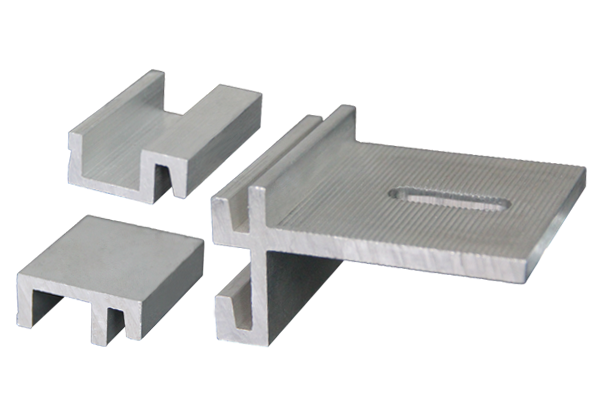
Figure 1. SE combination pendant
At present, edge-slot pendants hold about 80% of the market share, simply because their cost is lower than that of the back-bolt method.
Advantages of back-bolt stone curtain walls
The back-bolt stone curtain wall method was introduced from European countries; it uses back bolts to fix the stone and dry-hang it on the curtain wall.
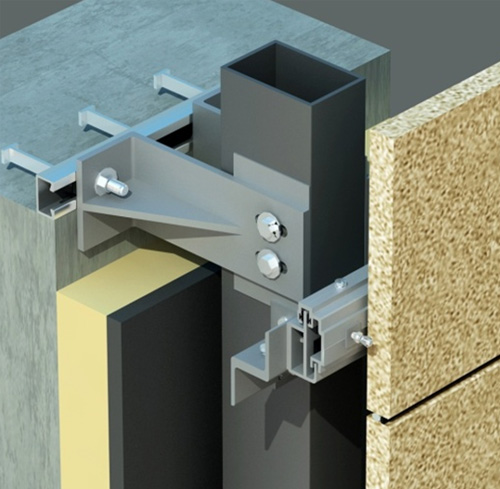
Figure 2. Back-bolt stone curtain wall
As shown in the figure, the internal structure of the curtain wall can be seen at a glance. We can briefly understand how the stone is dry-hung. First, during design, we determine the number and arrangement of back bolts according to the panel size, then drill holes in the stone and install the back bolts. The corresponding back bolt pendants can then be used to connect to the sub-frame.
If you are an expert, you will notice that back-bolt dry-hung cladding uses one more horizontal sub-frame member than the slotted method, along with a greater number of pendants; therefore the overall cost of a back-bolt stone curtain wall is considerably higher than that of the slotted method. This is why the back-bolt method has never become widely popular.
Given that back-bolt stone curtain walls are so expensive, why do people still use them? The main reason is their higher safety performance: back bolts are essentially stress-free after installation, each stone panel bears its own load, and their seismic performance has an incomparable advantage over the slotted method. Moreover, damaged stone is easier to replace: using the gaps between the stones, you only need to move approximately three panels above the damaged one to replace it.
Of course, care is needed when selecting back bolts. In some projects, panels have come loose some time after completion; the cause may be installation problems or problems with the product quality itself. We recommend that you choose a manufacturer with proper qualifications and corresponding tests when purchasing back bolts and matching products.
Further reading:
Uses and classifications of back bolts
How to select back bolts for dry-hung curtain walls
How to select aluminium alloy pendants for back bolts