

Even a small back bolt hole places great demands on installation, on the back bolt drilling machine, and on the back bolt drill bit; the dimensional tolerance fit between the back bolt and the drilled hole is very important.
The tolerance fit between back bolt and hole is important
Taking an M6 hammer-in back bolt as an example, when drilling, the straight-hole diameter is 11 ± 0.3 mm and the undercut diameter is 13.5 ± 0.3 mm. When the drill bit is new (assuming it meets the acceptance standard), the straight-hole diameter will be drilled somewhat larger, possibly reaching 11.3 mm, while the diameter of the back bolt's sleeve and of the bottom of its threaded rod are both 10.6 mm. If the thickness of the back bolt's expansion segment (ring) is only about 1 mm (normally 1.4 mm), then after expansion the diameter at the bottom is 12.6 mm, with only 0.65 mm embedded on each side. This is very dangerous: in a pull-out test the bolt may be pulled straight out rather than causing a conical failure of the panel.
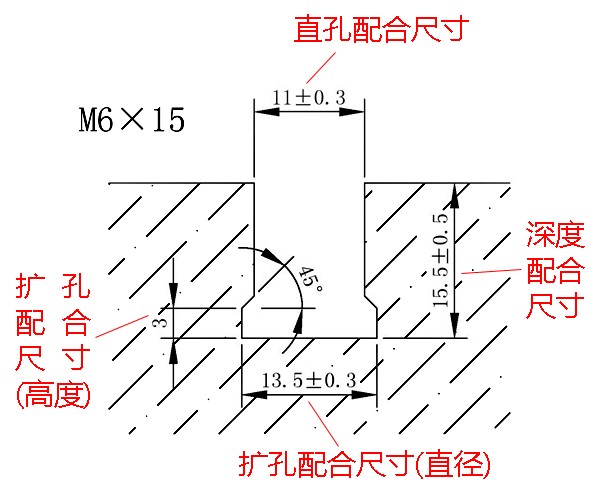
Figure 1. Drilling dimensional fit
When drilling a panel, there are the straight-hole diameter, the undercut diameter, the undercut height fit dimension, and the depth fit dimension; only when all four are combined can drilling accuracy be ensured. The same applies to the dimensions of the back bolt: only a complete tolerance fit can minimize risk. As a manufacturer, Daring strictly controls the dimensions of both back bolts and back bolt drill bits; while ensuring that the products are free of defects, it also provides the corresponding technical guidance for installation, so that problems can be avoided.
How to inspect back bolt holes
Before installing back bolts, we need to measure the dimensions of the back bolt holes. Generally, one inspection is required for every 30–50 holes. If any hole fails, all holes drilled with the same drill bit during that period must be checked one by one to ensure the acceptance rate of the back bolt holes.
Back bolt holes must be inspected using a hole gauge rod and a hole gauge. The hole gauge rod is used to check the straight-hole diameter and hole depth, while the hole gauge is used to check the undercut diameter. Used together, the two tools can effectively determine whether a back bolt hole is acceptable.
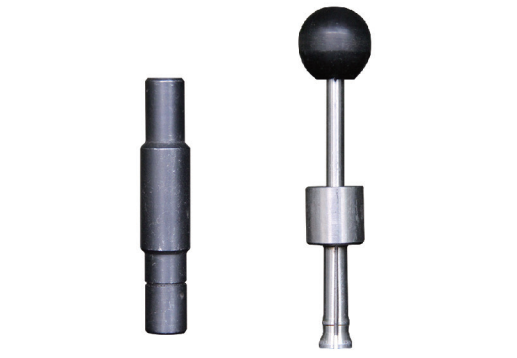
Figure 2. Hole gauge rod and hole gauge
Recommendations for contractors
Small back bolts, major risks: safety must always come first. Contractors must inspect the acceptance rate of back bolt holes themselves during construction. The construction industry now operates under a lifetime liability system, so only responsible companies will remain in the future. In addition, during construction the supervisor also oversees the project to ensure overall safety; if you do not carry out self-inspection, rework after problems arise will cost more than it saves.