

As a mainstream high-end dry-hung cladding method for curtain walls, the back-bolt stone curtain wall has always enjoyed an excellent reputation in the industry. Hammer-in back bolts account for more than 80% of back bolts used in stone curtain walls, so this article provides a systematic explanation of the installation technique for hammer-in back bolts.
Classification of hammer-in back bolts
Hammer-in back bolts can be divided into two types,ring-type hammer-in back boltsandsegment-type hammer-in back bolts, of which the ring-type hammer-in back bolt has the higher market share; the mechanical properties of the two are nearly identical on the vast majority of panels. However, the difficulty of machining the expansion ring of the ring-type hammer-in back bolt means that more than 50% of ring-type hammer-in back bolts on the market are substandard. The quality of the expansion rings produced by Daring has reached the level of imported brands and can ensure absolute safety.
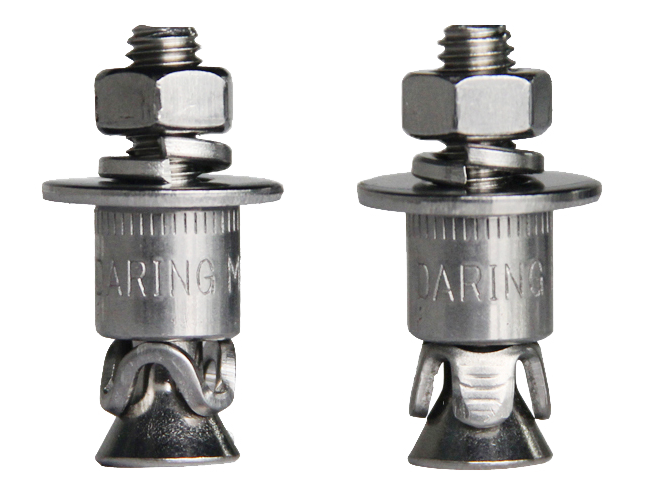
Hammer-in back bolt
How to install a hammer-in back bolt
Before installing a hammer-in back bolt, the back bolt hole must first be drilled in the panel,The width of the panel determines the arrangement of the back bolt holes on the panel, which is something that must be determined before drilling.
Installing a back bolt is actually quite simple; the installation steps are as follows:
(1) Remove the flat washer, spring washer, and nut of the back bolt and set them aside, then place the threaded rod and sleeve into the back bolt hole;
(2) Fit the driving sleeve over the threaded rod and strike the driving sleeve with a hammer until the back bolt sleeve is flush with the panel;
(3) Place the flexible gasket and the matching aluminium alloy pendant on the back bolt;
(4) Put the flat washer and spring washer in place and tighten the nut.
It should be noted that at least 3 mm of the back bolt threaded rod must remain exposed after installation to ensure that the assembly does not loosen. We mentioned aluminium alloy pendants above; generally, the aluminium alloy pendants used with hammer-in back bolts areflat ear pendantsandmale-and-female pendants (C-type pendants). Simply put, the former offers better value for money and is more widely used in projects; however, during construction it is necessary to pay attention to the overall length of the back bolt to ensure that it does not press against the matching angle bracket.