

As a pioneer of facade anchoring, the back bolt has been around for more than 20 years, but because of its narrow audience, many people in the construction industry have only a vague understanding of it. This article provides a detailed introduction to the back bolts available on the market, to help readers gain a deeper understanding of their uses and classifications.
Uses of back bolts
To discuss the uses of back bolts, we must start with facade anchoring solutions. High-end buildings generally use one of three approaches: glass curtain walls, stone curtain walls and new-type panel curtain walls. Early reports noted that many glass curtain walls had fallen, because most glass curtain walls are fixed with adhesives, and any adhesive will age over time, making the safety hazards of glass curtain walls difficult to resolve. In recent years, localities have successively introduced policies restricting glass curtain walls, and some special buildings are no longer permitted to use them. As for new-type panel curtain walls, this is a new industry; once a disruptive technology appears, it should develop into a new field within a few years. However, at present new-type panels have not yet reached a sufficient level, and the natural characteristics of stone are difficult to replicate, so stone curtain walls still occupy a pivotal position in high-end projects.
The small screw that fixes the stone is the back bolt. Back bolts are mainly used to fix exterior stone, though there are also back bolts used for dry-hung ceramic tile. Back-anchored stone curtain walls have now developed into a very mature technology; as long as construction quality is sound, the service life of the entire facade can reach over a hundred years.
Classification of back bolts
The types of back bolts available on the market are as follows: screw-in back bolts, hammer-in back bolts, anti-loosening back bolts and double-cut back bolts. Each is described below.
Screw-in back bolt: originally developed by Keyl, it is mostly used for fixing thin panels (generally ceramic tile), with thicknesses mostly in the 8 mm–20 mm range.
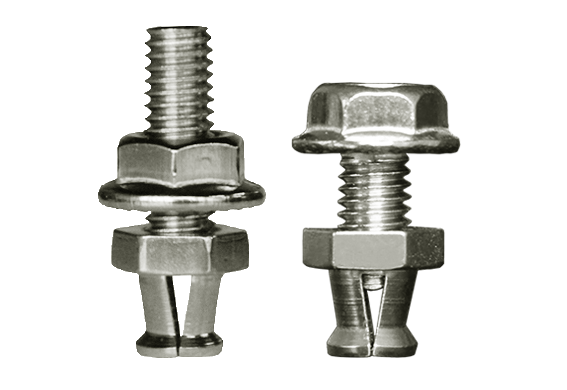
Figure 1. Screw-in back bolt
Hammer-in back bolt: originally developed by fischer, it is now divided intoring-type hammer-in back boltandsegment-type hammer-in back bolt, mostly used for fixing thick panels (generally stone), with thicknesses mostly above 25 mm.
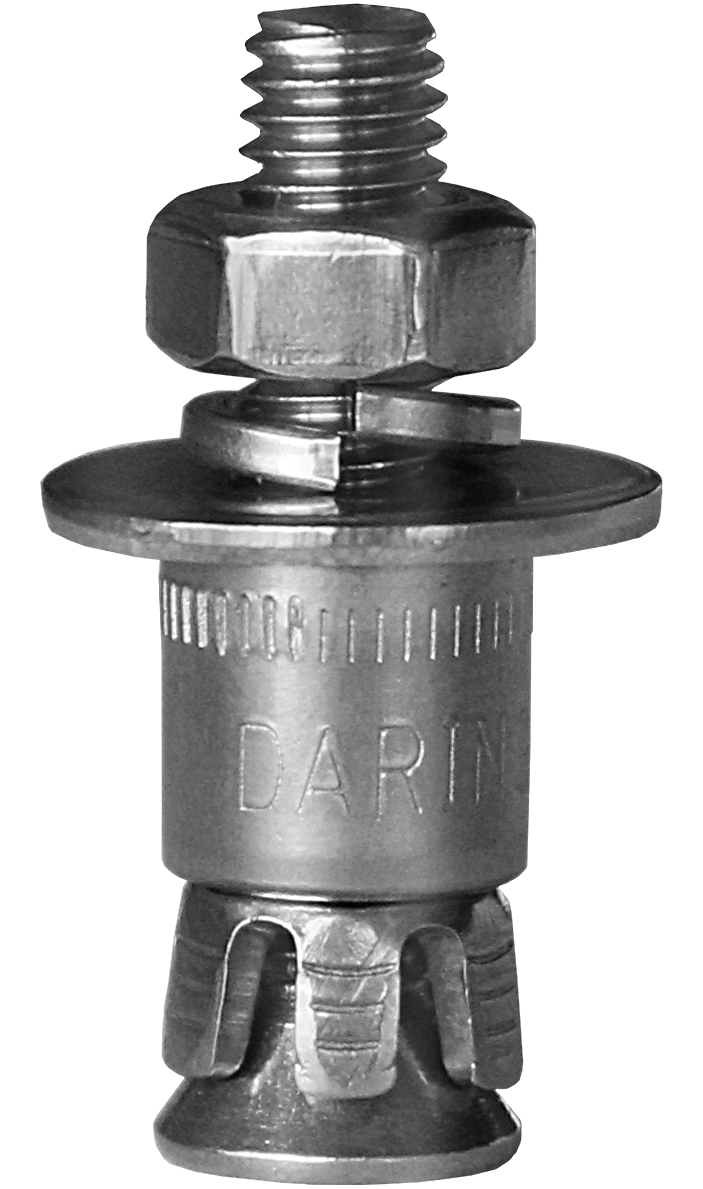
Figure 2. Hammer-in back bolt
Anti-loosening back bolt: originally developed by Beiluo, it can be used for fixing medium-to-thick panels (various panels such as stone and cement fiber board), with thicknesses mostly above 16 mm.
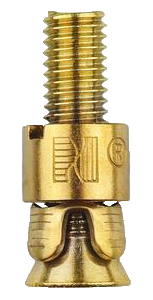
Figure 3. Anti-loosening back bolt
Double-cut back bolt: originally developed by Stai, it can be used for fixing thick panels (generally stone), with thicknesses mostly above 25 mm.
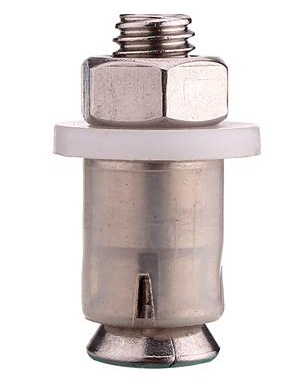
Figure 4. Double-cut back bolt
From the analysis above, only screw-in back bolts can be used to fix thin panels such as ceramic tile; the other three types are all used for anchoring medium-to-thick panels.
How to evaluate the four types of back bolt
If thin panels such as ceramic tile need to be fixed, the only option is the screw-in back bolt. However, when you visit a construction site you will find many cases of rough workmanship: back bolt drilling is a skilled task, and screw-in back bolts in particular place very high demands on drilling. Taking the M6×15 screw-in back bolt as an example, the drilling diagram is shown in Figure 5; the tolerances for depth and undercut are only ±0.2 mm and ±0.3 mm. By comparison, the M6×15 hammer-in back bolt has tolerances of ±0.3 and ±0.5, and its larger hole size makes it easier to work with, as shown in Figure 6. Moreover, new and used drill bits differ in size, and the slightest carelessness in operation can cause problems; not long ago there were several cases of stone curtain walls with screw-in back bolts falling off. Once a back bolt hole for a screw-in back bolt is drilled 1 mm or more too deep, the anchoring is essentially ineffective, and continuing to dry-hang the panels at that point is very dangerous. At present,the market share of screw-in back bolts is declining year by year。

Figure 5. M6×15 screw-in back bolt drilling diagram

Figure 6. M6×15 hammer-in back bolt drilling diagram
Now let us discuss the application of back bolts on thick panels. As noted above, hammer-in back bolts, anti-loosening back bolts, single-cut back bolts and double-cut back bolts can all be used to anchor thick panels. What are their respective advantages and disadvantages? Let us analyze them one by one.
After years of development, hammer-in back bolts are now mainly divided into two types: segment-type hammer-in back bolts and ring-type hammer-in back bolts. A layperson watches the excitement, while an expert looks at the details; experts know that the key to a ring-type hammer-in back bolt is the expansion ring, and the quality of the expansion ring determines the quality of the bolt. If you have the opportunity to attend trade shows, you will find that very few domestic suppliers can make a good expansion ring — Daring is one of them. Segment-type hammer-in back bolts are much better in this respect. The four-segment expansion currently produced by Daring is the most stable among segment-type hammer-in back bolts. It should be noted that some manufacturers produce five-segment or six-segment versions, which occasionally fail to expand properly when undercutting at the bottom; Daring has demonstrated this problem through specific experiments.
The anti-loosening back bolt resembles the hammer-in back bolt in appearance, but differs fundamentally in installation: the sleeve of the anti-loosening back bolt has threads and must be installed with a power tool. Compared with the hammer-in installation of hammer-in back bolts, the power-tool installation of anti-loosening back bolts gives a panel breakage rate of essentially zero, which is the advantage of the anti-loosening back bolt, especially for soft or highly brittle panels. In addition, the anti-loosening back bolt can be used on panels 16 mm and above, whereas the other three types apart from the screw-in back bolt can only be used on panels above 25 mm.
Now let us discuss the double-cut back bolt. What exactly is a double-cut back bolt? As its name suggests, it is a back bolt whose two surfaces (the bottom of the bolt and the top of the sleeve) are both tangent to the panel. This type of bolt is wrapped in a nylon sleeve, and the flat washer and spring washer are replaced by nylon washers. Drilling uses a double-cut drill bit which, in addition to producing a wedge-shaped hole in the panel, also creates a circular hole above the wedge-shaped hole the size of the nylon washer to accommodate it. This bolt is also known as a seismic back bolt. Having explained the principle, let us briefly analyze whether it is truly seismic. First, a seismic test report is the main factor in determining whether a back bolt is seismic; it is unknown whether the manufacturer can produce such a report for this bolt. Moreover, does the nylon sleeve wrapped around the bolt pose aging and fire risks? The product has only been on the market for a few years, so its aging resistance is still unknown, but nylon sleeves melt at high temperatures. The nylon sleeve itself occupies a certain thickness, and once it ages or melts, the bolt may loosen. As for the concept of the double-cut back bolt, a closer look reveals that all back bolts on the market meet the above definition — in other words, all back bolts are double-cut back bolts. The concept of double-cut/single-cut back bolts therefore does not hold up.